

What Is a Good Popup Conversion Rate?
Typical rates by type and trigger, what pulls yours down, and ten changes that raise it.
 Wahiduz Zaman
Oct 27, 2026
4 min read
Free Pro
For email signup popups, around 2 to 3% of views is typical and 5% or more is excellent. Omnisend’s 2025 data, from 1.24 billion popup displays, puts the average at 2.1% and grades rates as: below 1.5% underperforming, 1.5 to 3% average, 3 to 5% good, 5% and above excellent. Your own number depends heavily on the offer, the timing and how you count.
“What conversion rate should my popup have?” is one of the most common questions about popups, and the honest answer is “it depends on what you are counting”. A signup popup on a recipe blog, an exit offer on a shop and a click-to-open contact form measure very different things, so the first job is to be clear about what is being counted.
First, what is being counted
A popup conversion rate is conversions divided by views. The two words in that sentence hide most of the differences between benchmarks:
- Views: every time the popup was shown, or every visitor who saw it? Counting per visitor gives a higher rate.
- Conversions: a form submitted, a button clicked, or a purchase afterwards?
In Wing Popup Pro’s analytics, the rate is conversions divided by views, and you choose what a conversion is: a form submitted, the call-to-action clicked, or either.
Published benchmarks
| Source | Data | Average |
|---|---|---|
| Omnisend, 2025 data | 1.24 billion email popup displays | 2.1% per display |
| Sumo (now Bdow), 2016 | About 1.75 billion popups | 3.09%, top 10% at 9.28% |
Other vendors publish higher averages, often because they count differently or include high-converting types such as cart abandonment offers. Use benchmarks as direction, not as a target: the number that matters is your own rate, measured the same way over time.
What the data says moves the number
From the same Omnisend dataset:
- Timing: a delay of 6 to 10 seconds converted best; popups shown immediately underperformed.
- Mobile: popups shown on mobile converted at 2.2%; desktop-only popups at 1.4%.
- Games: wheel-of-fortune popups converted at 3.5%, compared with 2.0% without.
What pulls a popup below average
- No real offer. “Subscribe to our newsletter” gives no reason.
- Instant popups. Before the visitor knows whether your content is good.
- Too many fields. Every field after the email costs signups.
- Wrong pages. A newsletter popup on the checkout or contact page.
- Repetition. People who saw it three times have learned to close it on sight.
- Poor mobile layout. A popup that does not fit a phone screen loses most visitors.
Ten changes that usually raise the rate
- Make a concrete offer: a discount, a checklist, a schedule (“one recipe every Friday”). See lead magnet ideas.
- Write the benefit as the headline. See popup copywriting.
- Delay the popup by several seconds, or wait for a scroll.
- Ask for the email only.
- Match the popup to the page: a recipe offer on recipe posts, a product offer on product pages.
- Use a click trigger wherever a button can open the form; these visitors convert best of all.
- Design for phones first. See mobile popups.
- Respect “no” with long cooldowns after dismissal, so the people who see it are seeing it fresh.
- Reward instantly: show the code or the download link right after signup.
- Test one change at a time. See A/B testing popups.
Measuring your own rate
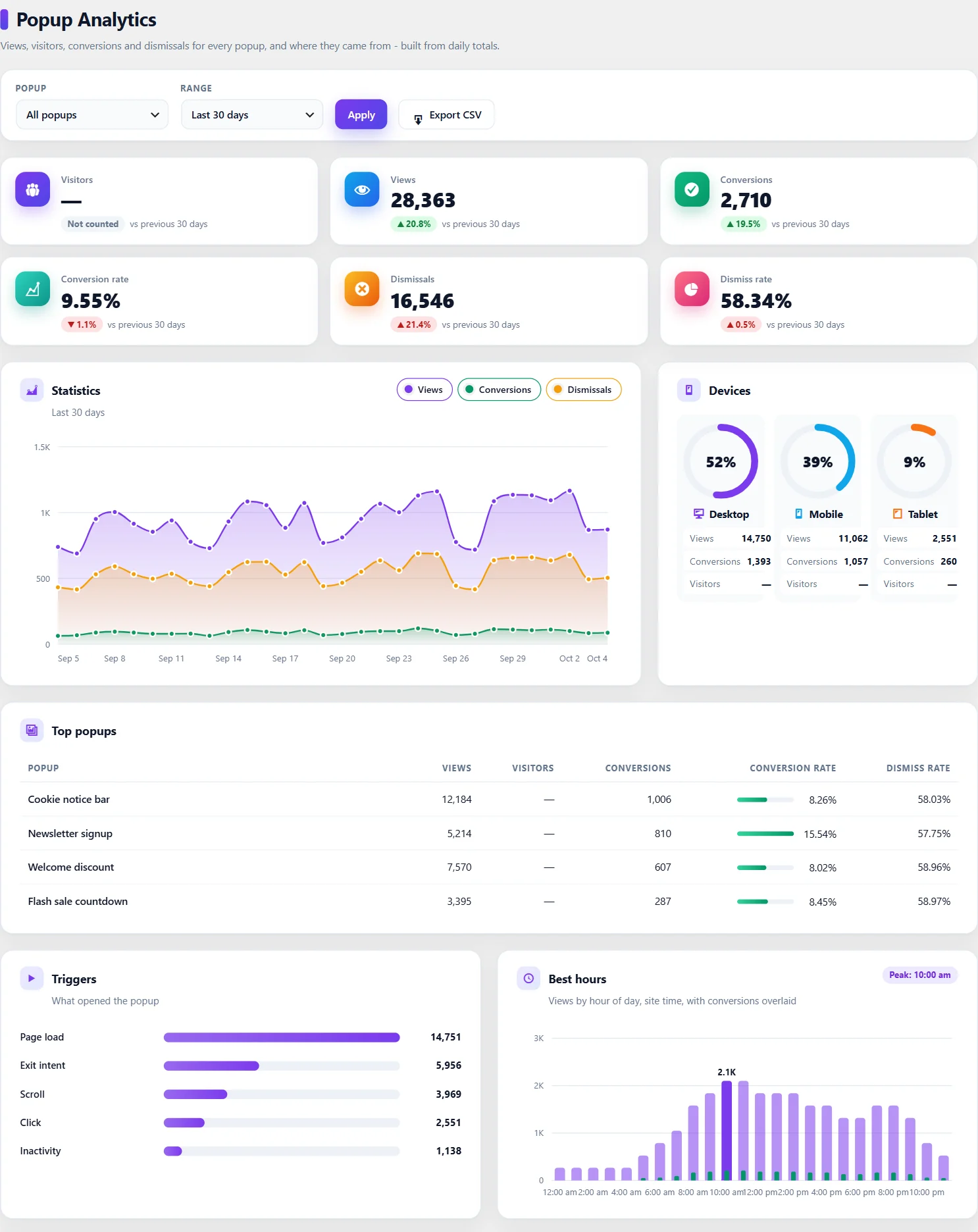
Wing Popup Pro’s analytics records views, conversions and dismissals per popup on your own site, with breakdowns by device, trigger, page, hour and day of the week. When we designed it we left out everything that identifies a person: no IP address, no full browser string, no user ID, no form contents, so the reports need no third-party service and add nothing to your privacy policy’s list of trackers. Three readings are especially useful:
- A high dismiss rate with few conversions: the popup is not wanted at that moment. Try a later trigger or a different offer.
- Triggers compared: if exit intent converts at twice the rate of page load, show the popup less on load.
- Devices compared: a popup that works on desktop may be too large or too early on phones.
Without Pro, compare signups in your email service week by week, and change one thing at a time.
Frequently asked questions
What is a good popup conversion rate?
For email signup popups, 3 to 5% of views is good and 5% or more is excellent, by Omnisend’s 2025 benchmarks. Click-to-open popups and exit offers to shoppers with a cart usually convert higher, because the visitor is already interested.
Why is my rate lower than the benchmarks?
Most often the offer is vague, the popup appears too early, or it shows on pages where it does not fit. Fix those before changing colours or wording.
Is a higher rate always better?
Not if it comes from discounts handed to people who would have bought anyway, or from signups who never open an email. Watch what happens after the conversion too.